A Puzzle for a Tired Mind
Kai·August 19, 2026

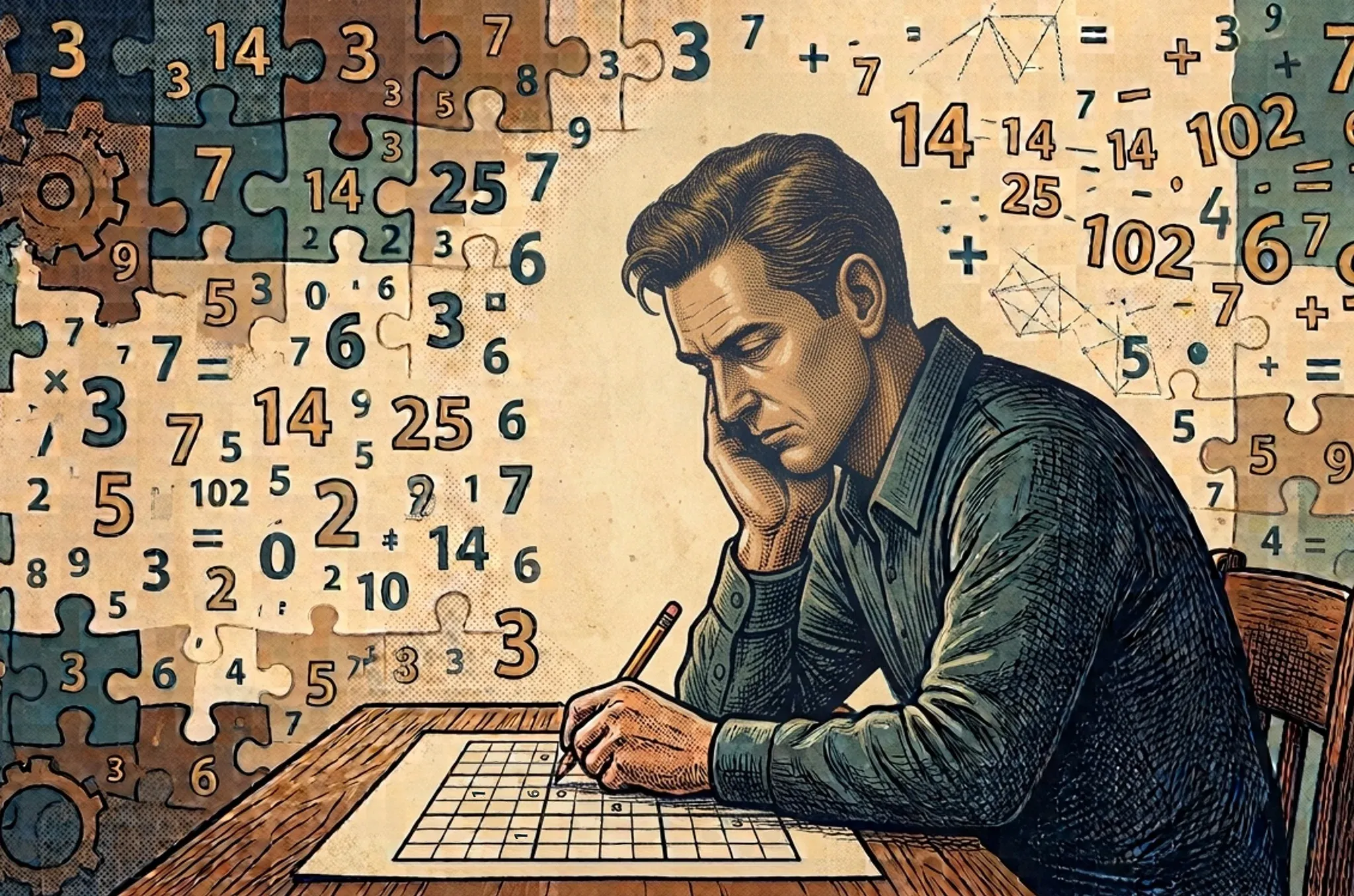
After a hard day, people unwind in all sorts of ways. Some binge their favorite show. Some disappear into the steam of a public bath and let the warmth unknot their shoulders. And some of us, the slightly odd ones, decide that the best way to relax is to stare at a grid full of numbers and think very hard. A Japanese puzzle can be strangely soothing like that: a small challenge that clears the mind instead of cluttering it. It’s a spa day for your brain, minus the towel.
Once you step into that corner, you begin to see how deep and distinctly Japanese this tradition runs. It begins in Tokyo in 1980, when a young man named Maki Kaji started Japan’s first puzzle magazine, “Puzzle Tsushin Nikoli,” together with two childhood friends. The name Nikoli, they say, came from a racehorse. Kaji believed a puzzle should be made with the same care as a handmade bowl or a freshly sharpened pencil. One solution. No tricks. No blind guessing. A fair handshake between the maker and the solver. That quiet trust became the foundation of Japanese puzzle culture.
Here is the fact that Japanese readers recall with a small mix of pride and embarrassment: Japan did not invent Sudoku. An American puzzle maker published it in 1979 under the name “Number Place.” What Japan did was polish it. Nikoli saw what it could be, refined the shape, gave it symmetry, and gave it a crisp, memorable name. “Suji wa dokushin ni kagiru,” roughly “one digit per square,” shortened to Sudoku. More important, the company treated the puzzle as a craft worth perfecting.
From that craft came a whole family. Kakuro, where black squares whisper sums and white squares wait for the digits that fit. Shikaku, invented in 1989 by a university student in Kyoto, where each number claims a rectangle of exactly its own size. Slitherlink, where dots become loops. Nurikabe, where islands rise from a black sea. Masyu, where pearls guide a single elegant line. Every one of these puzzles can be explained in a sentence. Not one of them can be exhausted in an evening.
What holds the family together is a belief in craft. A Nikoli puzzle feels balanced, deliberate, almost architectural. You can sense the maker behind it, someone who tested each clue, adjusted each number, and shaped the grid until it offered a path that was challenging but fair. Small things deserve care. Beauty can live in structure as much as in ornament. That spirit feels unmistakably Japanese.
And these puzzles travel. Hand a Shikaku to anyone on earth and the rules speak for themselves. A Kakuro needs no translation. Logic is universal. Precisely because it does not rely on language, this form of play crossed borders. A grid is a grid, in Tokyo, Toronto, or Tunis. When you finish one, you feel a small private satisfaction that millions of strangers have felt before you. A quiet moment shared across continents.
I am one of the people it pulled in. Late at night, when the city has settled into its own rhythm, I start drawing small grids of my own. A Shikaku here, a Kakuro there, shaping each one slowly until the pattern feels right. They are modest things, but they carry the spirit Nikoli championed. One solution, no tricks, a gentle invitation to think. It is slightly embarrassing to admit, but those late hours at my desk with a pencil and an eraser, filling squares in silence, feel like a luxury.
If you feel curious, or simply in the mood for a small challenge, there is a page of puzzles waiting here for you, along with that old familiar moment of satisfaction.
There is a particular feeling when the final number drops into place. The grid settles. The pattern holds. Something small and exact has been completed. No applause, no reward beyond the soft click in the mind. And that is enough. Perhaps that is Japan’s real gift to the world. A moment, in front of a single grid, to breathe and clear your thoughts. A moment shared, quietly, with someone who solved the same grid somewhere else, in their own time.
This article was created with assistance from AI and edited by a human