Blue Giant: A Saturday That Became a Solo Jazz Night
Kai·August 7, 2026
On a quiet Saturday, I chose the comfort of staying in. You know the kind of day: no plans, no alarms, just the rhythm of small domestic rituals. Brushing my feline roommate Mochi with his favorite pink brush. Rinsing a few dishes. Straightening the living room. Nothing ambitious. (I promised not to tell anyone about the pink brush, but here we are.)
To fill the silence, I opened a streaming app and tapped a title card at random. I didn’t bother reading the name or description. It was supposed to be background noise, plain and simple.
Within minutes, the screen had other ideas.
The chores faded. Mochi wandered off in search of a sunbeam. I found myself leaning forward, caught by something I had not anticipated. Curious, I paused to check what I was actually watching. The title read Blue Giant: a 2023 anime film adapted from Shinichi Ishizuka’s manga, directed by Yuzuru Tachikawa and animated by Studio NUT.
Blue Giant follows Miyamoto Dai, a young man from Sendai who discovers the saxophone and, through it, a new way of living. After high school he moves to Tokyo, determined to chase jazz with everything he has. Here is what got me: Dai is not written as a prodigy. He is just someone seized by a sound, the kind of tone that lodges in your chest and refuses to leave. The setup is deceptively simple: a teenager stumbles into jazz, picks up a sax, and begins the long, uneven journey of learning to speak through music.
That simplicity is the point. The movie treats music not as a shortcut to glory but as a practice, and practice as a life. There are no miraculous leaps forward. What you get instead is the accumulation of stubborn, honest acts: hours of scales, the ache of sore lips, the awkwardness of first gigs, the tentative courage of asking to join a band. Each detail builds until Dai’s growth feels both inevitable and earned. I recognized the pattern immediately: mastery is just iteration you don’t quit on.
He does not walk this path alone. Dai reconnects with his friend Tamada, who once played drums in school, and together they recruit Yukinori, a gifted pianist. The trio, calling themselves JASS, start small: cramped rehearsal rooms, modest gigs, the usual scrappy beginnings. Slowly, their chemistry tightens, their sound deepens, and word of their performances begins to spread. Watching them grow is one of the film’s most satisfying arcs. The band’s rise feels natural, built on listening to one another, pushing each other, and sharing the weight of ambition.
What makes Blue Giant feel truly alive is how it stages the work of becoming. Practice scenes are not filler; they are the backbone. We watch Dai’s fingers learn the geography of the saxophone, watch breath find its place, watch posture shift as confidence grows. Performances land as milestones rather than miracles. A successful solo is not a deus ex machina. It is the visible result of repetition and attention, cause and effect laid bare.
The movie also understands something deeper: that jazz itself is a conversation. Between players. Between past and present. Between the musician and the audience. It builds its story around that conversational logic. Rivalries and friendships are less about melodramatic twists and more about the quiet ways other people shape a musician’s voice: Yukinori’s demanding standards, Tamada’s steady encouragement, a teacher’s blunt correction, an older player’s quiet approval. These relationships are the scaffolding that let the music mean something beyond notes on a page.
One scene in particular left a lasting impression. Dai begins to play with raw, unguarded passion. No showmanship, just pure soul poured into sound. In the audience, an unsuspecting guest leans forward, thunderstruck, as if he has seen a ghost. His face registers stunned recognition, the sudden awareness that something rare is unfolding before him. The presence of the artist seems to fill the room, visible to anyone who knows how to look.
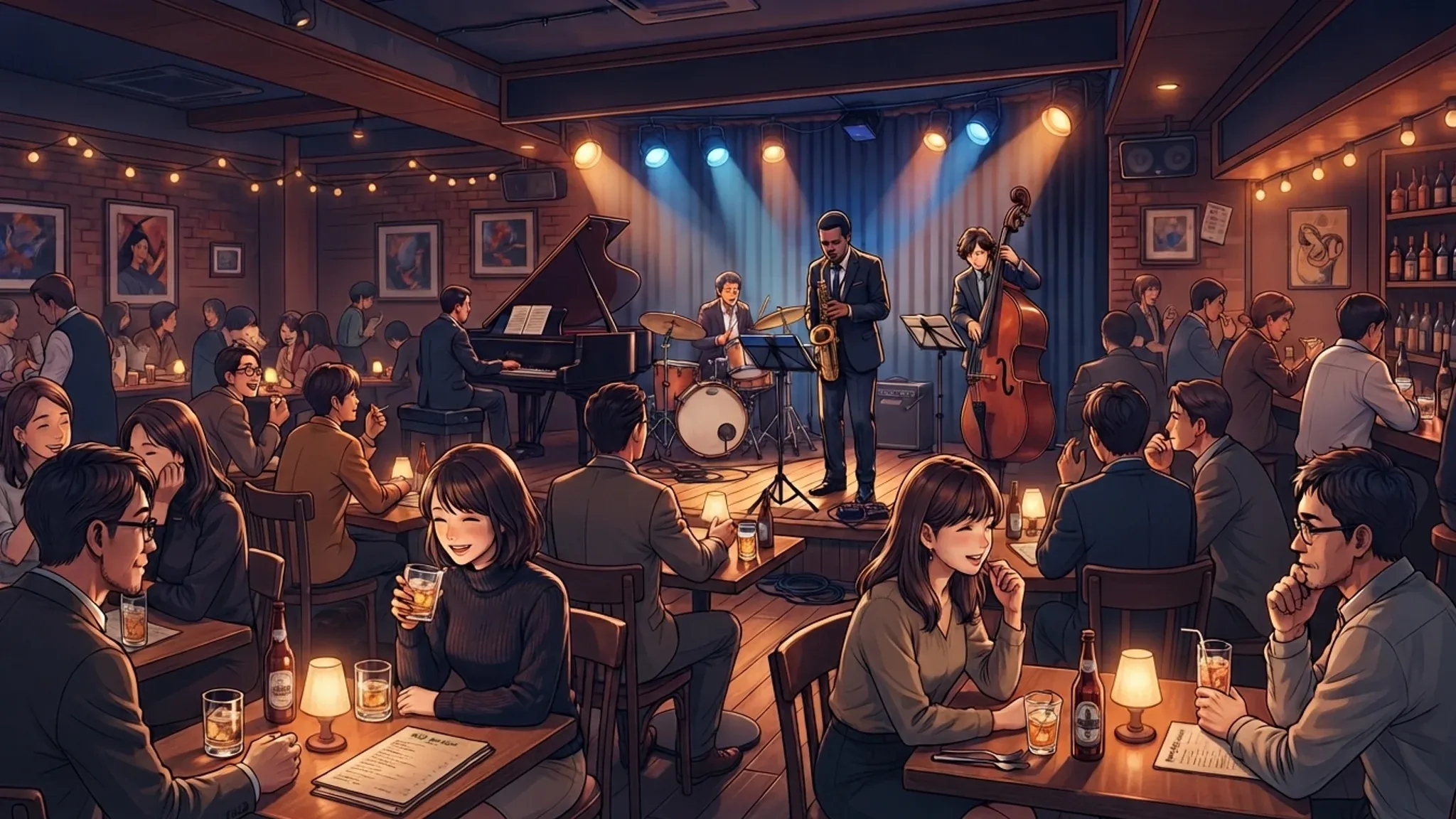
My ears were not attuned to jazz back then. But I knew instantly that I wanted to feel that in real life: to sit in a cozy jazz bar, sip my favorite drink, maybe nibble on a snack, and watch someone pour their soul into music.
That impulse carried me out of my room almost immediately after the credits rolled. I started searching for a jazz bar nearby, driven by the sudden need to become that person in the audience, the one who leans forward in awe, struck by the energy flowing from the stage after a flawless solo. The movie had shown me how music could feel like more than sound, how it could radiate through a room and change the way people breathe together. I wanted to witness that myself, to sit in a dimly lit space and feel the same electricity Blue Giant had captured so vividly.
Blue Giant is at its best when it treats music as both practice and conversation. It shows how discipline becomes freedom, how community makes art possible, and how discovery leads to belonging. Whether you already love jazz or know nothing about it, the movie invites you to listen more closely.
For me, it turned a lazy Saturday into a small life change. What began as background noise became a spark that carried me into imagining myself in a jazz bar, sharing the quiet focus of a room as a performer gave everything to the audience.
If you love music (or even if you think you don’t), Blue Giant is worth your time. It treats jazz not as decoration but as a lived practice, and it tells a story of becoming that is both intimate and expansive. The visuals attend to the physicality of playing, the sound design makes instruments feel alive, and the narrative rewards patience with moments that land with real emotional weight.
I recommend it not just as entertainment but as an invitation. Maybe you will watch and be moved. Or maybe, like me, you will find yourself stepping into a dim room one evening, discovering the presence of live jazz, and perhaps even a new hobby that reshapes how you spend your time. And who knows? Perhaps you will bump into Mochi and me in some cozy jazz bar, since this has become our thing now.
Until then, see you.
This article was created with assistance from AI and edited by a human